
Shop Rate: The Number That Decides Whether Your Maintenance Department Is a Cost Center or a Business
Every maintenance department has a budget. Technician wages, benefits, shop utilities, tooling, training, supervision — the list of costs required to keep a maintenance operation running is long, and every dollar on that list has to come from somewhere. The question is: where does it go?
In a perfect world, every dollar your maintenance department spends gets allocated to the equipment it supports. When your mechanic rebuilds a hydraulic cylinder on unit 302, the full cost of that work — not just the parts, but the true cost of having that mechanic in your shop, with your tools, under your roof — gets charged to that asset. When all the costs are properly distributed, the maintenance department's books balance. Spend in, allocation out, nothing left floating.
In reality, most maintenance operations don't get anywhere close to that. They track parts. They might track labor hours. But the rate they use to value those hours doesn't reflect the actual cost of running the shop. The result is a gap — a bucket of unallocated overhead that sits on the maintenance department's ledger and makes the whole operation look like a cost center that can't justify its own spending.
That gap is a shop rate problem.
What Shop Rate Actually Is
Shop rate is the fully loaded cost of one hour of maintenance labor. Not just what you pay the technician — the total cost of delivering that hour of wrench time, including everything it takes to make that hour possible. Tenmil is heavy equipment maintenance software that charges every work order labor hour at this rate, which is why we care about getting it right.
Start with the technician's base wage. A heavy equipment mechanic making $38 per hour has an obvious, visible cost. But that's the starting point, not the finish line.
Benefits add substantially to the real cost. Health insurance, retirement contributions, paid time off, workers' comp — these typically add 25-40% on top of base wages. Published technician wage and benefit figures are in our heavy equipment maintenance statistics. Your $38-per-hour mechanic actually costs the company somewhere in the range of $48-$53 per hour once benefits are factored in. That's the fully burdened labor rate, and it's the minimum your shop rate needs to cover.
But a fully burdened labor rate still isn't a shop rate. A shop rate includes the overhead required to support that technician's work. Think about what it actually takes to run a maintenance shop: the building itself (rent or mortgage, property taxes, insurance), utilities (power, heat, water, waste disposal), shop equipment and tooling (service trucks, lifts, diagnostic equipment, welding rigs, specialty tools), consumables (rags, solvents, lubricants, welding supplies that don't get charged to specific work orders), IT systems (your CMMS, parts management software, any diagnostic subscriptions), supervision and management (the maintenance manager's salary allocated across the team), training and certifications, and administrative support.
All of those costs are real. All of them are necessary. And all of them need to be recovered through the work your technicians perform. Shop rate is the mechanism that makes that happen.
The Math Behind Shop Rate
The calculation itself is straightforward. Take your total annual maintenance department overhead — every cost listed above — and divide it by the total number of billable labor hours your shop produces in a year.
That second number is important: billable hours, not paid hours. Your technician works 2,080 paid hours per year, but they're not turning wrenches for all of them. Subtract holidays, vacation, sick time, training days, shop meetings, and non-productive time, and the hours actually logged against work orders come in well under that. The exact number depends on your operation, but the point is that it's significantly less than the total hours you're paying for.
If your total shop overhead — everything from wages and benefits to the electric bill and the CMMS subscription — comes to $900,000 per year, and your team produces 5,000 billable hours, your shop rate is $180 per hour. That's what one hour of your shop's time actually costs when you account for everything.
Most internal shops dramatically understate this number. They'll use the technician's base wage, or the burdened labor rate, or some rough estimate that felt right five years ago and has never been revisited. A shop using $45 per hour when the real rate is $180 per hour is under-allocating $135 for every single hour of work performed. Multiply that across thousands of work orders per year and you've got a massive pool of unrecovered costs sitting on the department's books.
The Overhead Black Hole
Here's where the problem becomes visible. When your shop rate is too low, the costs you allocate to equipment through work orders don't add up to what the department actually spends. The difference has to go somewhere, and it ends up in an overhead bucket — a general cost pool that isn't tied to any specific asset or work order.
This creates several problems that compound over time.
First, your equipment cost per hour is wrong. If you're using shop rate to build your cost-per-hour calculations (and you should be), an understated rate means you're underestimating what each machine actually costs to maintain. That flows directly into underbidding, poor replacement timing, and bad rent-vs-own decisions. Every downstream calculation that depends on accurate maintenance cost is compromised.
Second, the maintenance department looks more expensive than it should. When a significant portion of your budget sits in an unallocated overhead bucket, leadership sees a maintenance department that can't fully account for its spending. The work is being done — the labor, the repairs, the PMs — but the financial picture doesn't reflect where the money actually went. This makes the department a target during budget season, because the overhead pool looks like waste or inefficiency when it's actually just poor allocation.
Third, you lose the ability to make meaningful asset-level decisions. If only a fraction of your true maintenance cost is being allocated to each machine, you can't accurately compare maintenance spend across similar assets. You can't identify which machines are becoming maintenance-heavy. You can't spot the unit that's costing you twice what its siblings cost because the numbers only tell part of the story. The rest is buried in overhead where it helps nobody.
Fourth, it creates a distorted picture of in-house versus outsourced work. When you send a machine to a dealer for repair, that invoice captures the full cost — their shop rate includes their overhead, their tooling, their facility costs. It's all in the number. But when you do the same work in-house at an understated shop rate, the recorded cost looks dramatically lower. That makes in-house work appear cheaper than it actually is, which sounds like a win until you realize the difference is just landing in your overhead bucket instead of on the asset where it belongs.
Getting Shop Rate Right
Building an accurate shop rate requires an honest inventory of every cost your maintenance operation carries. Nothing gets left out. If it's a cost required to keep the shop running and the technicians working, it belongs in the calculation.
Start with a complete list of direct and indirect costs. Wages, benefits, facility costs, utilities, equipment, tooling, consumables, technology, supervision, training, administrative support — all of it. Be thorough. The costs you forget to include don't disappear; they just end up in the overhead bucket you're trying to eliminate.
Then get honest about billable hours. Track how many hours your technicians actually spend on work orders versus how many hours they're on the clock. This is where a CMMS becomes critical — if your technicians are logging time against work orders consistently, you have real data instead of estimates. If they're not, start there. You can't calculate a meaningful shop rate without knowing your denominator.
Divide total costs by total billable hours, and you have your shop rate. Review it at least annually, because costs change — wages go up, insurance premiums shift, you add or lose technicians, facility costs change. A shop rate calculated three years ago is probably not accurate today.
The number might be higher than you expect. That's the point. If your true shop rate is $180 per hour and you've been using $50, you haven't been saving $130 per hour — you've been hiding it in overhead. Correcting the rate doesn't increase your costs. It reveals where they've been going all along.
How a CMMS Makes This Work
Shop rate only matters if it's actually applied consistently across every work order. That's where the system matters. A CMMS that tracks technician time against work orders and applies your shop rate automatically ensures that every hour of labor gets allocated to the right asset at the right cost. There's no manual calculation, no spreadsheet reconciliation, no forgetting to apply the rate on a Friday afternoon when someone just wants to close out their work orders and go home.
When a technician logs 6 hours on a transmission repair, the system multiplies those hours by your shop rate, adds the parts costs from inventory, includes any third-party charges from the associated purchase order, and allocates the full cost to that asset. Every work order, every time, consistently.
Tenmil's heavy equipment shop management software handles this natively. Labor time is captured on every work order, shop rate is applied automatically, and the resulting cost data feeds directly into live asset-level analytics. There's no separate step to compile labor costs, no batch processing at month end, and no manual rate application. The cost allocation happens as the work happens.
The result is that your maintenance department's total spend gets distributed across the equipment it supports — which is exactly where it should be. The overhead bucket shrinks because the costs that used to pool there are now being allocated to specific assets through properly rated work orders. Your equipment cost-per-hour numbers become accurate because they include the true cost of in-house labor. And your maintenance department stops looking like an unexplainable cost center, because every dollar can be traced to the work that consumed it.
The Bigger Picture
Shop rate isn't glamorous. It's not the kind of metric that gets discussed in strategy meetings or printed on dashboards. But it's the mechanism that connects your maintenance department's spending to your equipment — and without it working correctly, there's always going to be a pool of unallocated cost that makes the department look inefficient and makes your asset-level data unreliable.
Getting shop rate right doesn't reduce your costs. It shows you where they actually go. And once you can see that clearly — once every dollar of maintenance spend is sitting on the asset that consumed it — you can start making real decisions about your fleet, your bids, and your operation based on numbers that actually reflect reality.
The maintenance department isn't a cost center. It's the operation that keeps your revenue-generating assets generating revenue. Shop rate is how you prove it.
Want your own number? Run your department's figures through our free shop rate calculator — the same loaded-rate math this article describes, with the direct labor and overhead split broken out per billable hour.
Related
Put this to work on your own fleet with Tenmil's shop rate calculator.
Related articles
Is Your Equipment Actually Being Paid For? Internal Rates and the Recovery Gap
Every contractor charges its own projects for its own iron. If that internal rate isn't built from real cost per hour, the fleet quietly under-recovers, and the shortfall hides in overhead where nobody can see it.
When to Replace a Machine: The Cost Curve Nobody Draws
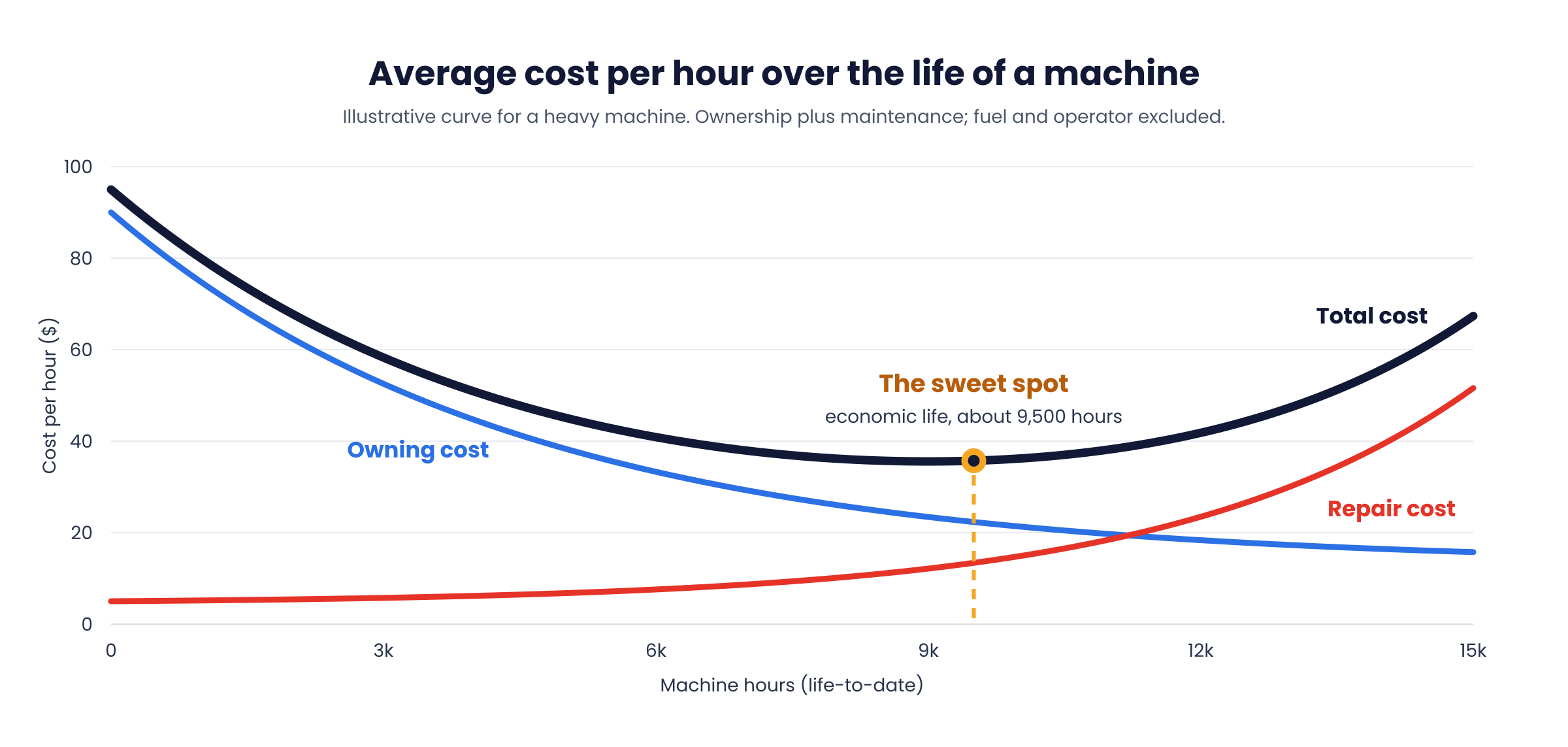
Every machine has a point where it costs less per hour than it ever will again. Most fleets trade too early or run right past it, because nobody is drawing the cost curve that shows where that point is.
The Hidden Revenue Engine: Why Equipment Cost Per Hour Is the Most Important Number in Your Fleet
Your equipment doesn't just sit on a jobsite — it earns. Cost per hour tells you exactly how much it costs to generate that revenue, and getting it wrong means you're bleeding money on every bid.